


Redeeming Holiday Stress

Thanksgiving - Christmas - New Years: Annual Triumvirate of Stress Producers

As the major holidays come rolling around, we can look forward to fun, family, and celebration. But let's not forget we can also expect added stress!

Here are a few common contributors:

  • working long hours
  • fighting traffic
  • travel / vacation
  • caring for aging parents
  • cleaning dirty dishes / house
  • paying the added bills / increasing credit card debt
  • finding time to get everything done
  • Staying on a diet
  • Pressure of giving or getting gifts / struggle to afford and to purchase material goods
  • family gatherings
  • taking charge of holiday celebrations, preparing meals and decorating the home
  • hype and commercialism of the season / advertising pressure us to buy more and more expensive gifts
  • lacking time and money
  • parenting your kids
  • not able to relax
  • feeling the duty to make the holidays the best ever for your family
  • work responsibilities might interfere with time spent with the family
  • worry about getting enough time off of work and

Are you feeling thankful yet LOL!

But seriously, how many of those are on your plate? The more challenges you’ve got, the more support you’ll need to thrive this holiday season. So how will you manage your elevated stress levels?

Here are some common strategies:

  • watching TV
  • sleeping
  • eating and drinking
  • religious activities / reconnect with faith
  • do nothing
  • play / listen to music
  • exercise
  • meditation
  • prayer
  • read

All of these can help and some are healthier than others but for even more value from your stress, how about a long term plan that is visionary, inspiring and validating of what matters most to you? Wouldn’t that be pretty awesome?

With the new year only 35 days away,  how would you like to change, grow and develop to not only be a better stress manager but really thrive?

Here are some worthy goals:

  • improve health  
  • lose weight
  • get finances in order
  • improve relationships with family or a significant other
  • find a better / less stressful job
  • pursue further education
  • pursue recreational interests      
  • find more affordable / comfortable housing    

All of those are great goals but can we squeeze even more value from our stress? What if we could align our plan with a whole hearted view of life to give greater meaning, inspiration, encouragement, and effectiveness to achieving those goals and more?

incarnation2
incarnation2

I think Christmas can provide us with some insight into this kind of perspective. The Incarnation.Through Jesus, God’s universal governing principles became flesh and blood (John 1:14) - a living, human being!

"The Word (logos)became flesh and made his dwelling among us."

And through Him, unconditional love, unfathomable peace, unstoppable hope, and unlimited joy was revealed and made accessible to everyone who would believe, receive and apply this incarnation to their lives. Through the omnipotence of vulnerability and empathy, the source of meaning, creativity and vitality has been manifested. And this power is available to all of us regardless of ethnicity, gender, social-economics, or whatever other label and category is out there. Incarnating the valuing of people, their healing and their positive development helps us maximize the redemption of stress. And not only stress but also other major negative, inner life experiences like shame, suffering, and pain.

What I’m getting at is embracing a central character of courage, compassion, and connection. That's what God did in Christ!

Why? Because those are the elements we desperately need to live, lead and love well.

slippery-slope
slippery-slope

What consistently hijacks our effectiveness, peace and well being? Interpersonal conflict. We suck at it. Being bad at this has ruined so many families and it’s why dysfunctional homes and organizations are not uncommon. The way we engage and resolve conflict, our management of negative emotions and the way we reconcile is a primary determiner of the quality of our relationships and culture and ultimately the character development of everyone in it. Do it well, and our homes and work spaces become places of emotional and social and even spiritual wellness. Do it poorly or not at all and end up with hypocrisy, dysfunction, false bonds, isolation, hostility or all the above. Without this core of 3 C’s, we will inevitably waste the stress and pain of life and actually end up doing all we can to avoid or hide it rather than redeem it.

Without 3 C's conflict resolutions, we develop strong tendencies of avoidance, people pleasing, idealization, control, and hiding. We get addicted to being right and become unapproachable. When we and others get stuck in unhealthy patterns, we lose sight of what matters most and if children are around, they will become handicapped with emotional and relational baggage stopping them from meaningful connection and achieving their full potential.

core-muscles-stability

As the new year arrives, will you be redeeming holiday stress by growing a stronger core of courage, compassion, and connection? Moreover, will you be an agent of transformation in your home, your school and work with a presence of vulnerability, elevating trust building to new heights?

Take time to talk to those close to you to generate a vision and plan for growth and development. Then share it with a team of supporters to encourage you and hold you accountable for real change resulting in real outcomes! May 2016 find you redeeming the gift of time, especially the tough times. Blessings!

What's possible with a strong growth mindset?

In my previous post, I talked about what a growth mindset is and what it's good for. I'd like to continue here with additional possibilities of not only having a growth mindset but a beefed up one - ie juiced (figuratively speaking of course). What if we were to create environments around ourselves, our loved ones, and even our work places to get everyone into a mode to readily learn new things, process them, and rigorously exercise trial and error to improve, develop, and achieve radically creative / innovative solutions? More importantly, doing all that without the relational shackles caused by insecurities, needs for approval, and dysfunctions driven by fear. What would happen to our hearts? Our homes? Our organizations? Our communities and cities?

When we can recognize mistakes (especially the ones that we feel humiliate / shame us) as things to learn from rather than avoid, we're able to leverage the power of vulnerability. Initiating without fear of rejection, risking without fear of loss, moving forward without need for certainty, allowing ourselves to be deeply seen and known, courageously believing that we are worthy of love and belonging totally apart from what we do - these are all necessary to being truly alive, passionate, and full of desire and love.

Nelson Mandela quote

When we are free to embark on the adventurous journey of living whole heartedly, we are on the path to authentic and powerful validation. Rather than settling for what has always been done, what is safe and lifeless, or just breadcrumbs of profound love, joy, and peace, we can boldly explore where love and desire want to lead us. A vibrant life is one where we are growing, learning, and changing to become better connectors, spouses, parents, and leaders who serve and develop future generations to do greater things with increased freedom, compassion and justice. We have yet to see what would happen if every individual were substantially and dynamically validated, empowered by empathy to have a fortified growth mindset, given the freedom and courage to creatively and meaningfully come up with profound and impactful solutions.

122-Lincolns-Famous-Failures

With a strong growth mindset would come greater values of collaboration, communication, and community because fear of not being, doing or having enough would not have the ability to cause jealousies, dissensions and manipulations (and other dysfunctions) - ugly and toxic politics. The growth mindset is not hungry for approval and it recognizes the joy and power of everyone succeeding; it's not threatened by others' successes. With consistent focus and attention on what it takes to improving together (working with emotional and relational health), there is the safe space needed to learn from mistakes which paves the road to real wisdom. And this wisdom is what truly brings us together in authentic unity.

With greater collaboration, communication and community comes greater diversity. With the validation of each person's uniqueness, the bonding through increased valuing of each other, we can experience the beauty and power of differing capacities, perspectives, and leadership. When diverse members of an organization, especially the leaders, are growing and developing truer personhood, partnerships, and presence, everyone benefits because there will be the reciprocity of feeling uniquely understood and valued, the constituents by the leaders and vice versa. Challenges become opportunities for innovative solutions. Collaborative creativity increases the likelihood of seeing what is most important to bring more positive impact and value to more people.

Allen Kagina
Allen Kagina

With greater diversity of individuals collaborating, there is an environment conducive of a grander vision. When more perspectives can come together, able to see and synthesize with each other's strengths and differences, there will be deeper understanding into problems and challenges. In addition, with meaningful trust in place, there is a foundation for rigorous communication to explore and discover new best practices, solutions, and ways of being and working. Grander visions set direction for the profound change, impact and sustainable transformation our world desperately needs.

A strong growth mindset is what we all need, regardless of life stage. "You can't teach old dogs new tricks" is an unrecognized default caused by finding our worth in what we do rather than who we are. Benjamin Bloom (creator of Bloom's Taxonomy of Learning) concluded from 40 years of research "What any person in the world can learn, almost all persons can learn, if provided with the appropriate prior and current conditions of learning.”  To create conditions of learning, we need to get rid of the insecurity, anxiety and fear caused by the performance based mindset, and instead, center our worth on unconditional love, emotional health, and strong relationships. With this shift, we will find that to grow, learn, change, and improve in almost anything simply requires time, instruction, development, effort and of course, mistakes and failures!

Newsletter: A Beefed Up Growth Mindset

*|MC:SUBJECT|*
What's possible with a strong growth mindset?
View this email in your browser
Check out my e-course and parenting workshops!

In my previous post, I talked about what a growth mindset is and what it's good for. Pretty obvious it's good for a lot of stuff. But what if...
What if it was beefed up?
 You know, juiced! What if we created environments around ourselves, our loved ones, and even our work places to get everyone into a mode to readily learn new things, process them, and rigorously exercise trial and error to improve, develop, and achieve radically creative / innovative solutions? More importantly, doing all that without the relational shackles caused by insecurities, needs for approval, and dysfunctions driven by fear. What would happen to our hearts? Our homes? Our organizations? Our communities and cities?

What if we experienced more of these?
  • Meaningful Validation
  • Communication, Collaboration, Community
  • Greater Diversity
  • Grander Vision
Shouldn't these become the norm rather than hopeful ideals shackled by fixed mindsets?

Read on here.

I know some of you may not be feeling it and that's cool. In the next issue, I'll talk some about things that kill this kind of stuff and it begins with an "r".
PARENTING TIP: (click on pic to learn about success being a journey)
We all want our kids to be successful but often times forget what the road to get there looks like. With all those twists, turns and switch backs, how do we help them stay on course? Foster these 8 things (click on pic):

How?
Centrally prioritize healthy relationships.
Why?
Healthy relationships give life to our hearts, the source of those 8 things. It's also what our kids need most. Try these tips for starters. Look for an e-course coming soon on this!
Copyright © *|CURRENT_YEAR|* *|LIST:COMPANY|*, All rights reserved.
*|IFNOT:ARCHIVE_PAGE|* *|LIST:DESCRIPTION|*

Our mailing address is:
*|HTML:LIST_ADDRESS_HTML|* *|END:IF|*

Want to change how you receive these emails?
You can update your preferences or unsubscribe from this list

*|IF:REWARDS|* *|HTML:REWARDS|* *|END:IF|*

CREATING A GROWTH CULTURE

If we want the very best for our families, we need foundational fundamentals that will keep all members moving forward towards greater emotional and relational maturity that will cultivate deeper connections as time goes on. What might that fundamental be?

Brain - fixed vs. growth mindset

FAMILY FOUNDATION FUNDAMENTAL: Self awareness that empowers and equips us to move our family forward in what matters most.

To make this happen, a growth mindset in the area of emotional and relational health is absolutely essential. It's terrible when mom, dad, or kids feel like they can't change the negative ways they relate and respond. So they get busy and distract themselves rather than learn how to grow.

Looking at the graphic, it's easy to see why the growth mindset should be preferred:

With a growth mindset...

  • We're passionate for learning rather than being hungry for approval.
  • We can see failure as growth rather than something to avoid.
  • We can experience meaningful improvement rather than just acquire head-knowledge.
  • We recognize the joy and power of everyone succeeding together.

But where do fixed or growth mindsets come from?

Well, the root of both is a desire to be loved and valued and this is where it gets critical. If it's achieved by performance and success and this becomes a default, there's a higher likelihood to grow a fixed mindset. That's because focusing on how we look or what we do is motivated by approval - others and / or ourselves. When approval becomes the priority, learning and growth take a back seat because often times, it's not pretty or impressive to learn and go through phases of change. Actually quite the opposite - as in awkward, stupid, embarrassing, etc.

In contrast, when the desire to be loved and valued is met apart from what we do, ie. we are greatly loved and valued unconditionally, we are much less likely to be afraid of the effort, uncertainty and difficulty of new and higher challenges. This gives rise to the growth mindset which gets us on the road to wisdom.

How does this happen? Well, the road to greater character development is always paved with lessons from mistakes. This means mistakes are necessary and thus we should value them properly rather than trying so hard to prevent them. Of course not all mistakes are created equal. Most are affordable; some are not. But there is no significant, substantial growth without mistakes and learning from them. Definitely the most important thing is the learning. And so to maximize it, we want our minds to be in learning mode as much as possible - the growth mindset.

Yet there is something even more foundational than learning from mistakes and that's being able to learn from mistakes. There is this capacity / way of being that opens up the learning channels; it's empathy. This ability to experience another person's feelings, thoughts or attitudes, to identify fully with another so as to be able to say, "Me too!" is absolutely necessary for turning lemons into lemonade. When we're with someone who authentically knows and understands us, where we feel loved, accepted and even embraced, this gives us the freedom to receive new learning, especially difficult learning like from mistakes and other painful experiences. Empathy gives us the courage, security, and freedom to not be afraid to try and fail, to do things wrong and be able to sit with the error, process it, analyzing and evaluating it, to see how it might help and serve us to be and do better.

To foster the development of the growth mindset, mistakes and learning are essentials but even more important is the regular presence of healthy empathetic people, ie. relationships that feed our deepest needs for unconditional love and acceptance. This food is what shapes our sense of self. In other words, we become the culmination of our most precious relationships. It's said, we're the average of our 5 closest relationships. When our personal connections are robust with trust, forgiveness, safety, love, and vulnerability, we become free from anxiety, insecurity, and fear. Free to learn, experiment, fail, learn more, try again, persevere, muster up greater courage, and ultimately be who we really want to be, showing up as we really are.

Developing this foundation fundamental of self awareness is what grows empathy in us. It all starts with an environment of courage, transparency and humility. Check out my e-courseon this.

Creating a growth culture starts in our own minds. Where are we finding our value, love, and sense of belonging? What foundation are you building on? I hope it's categorically a self awareness that leads to empathy.

My desire is to consistently grow towards this way of being, free to learn from mistakes, growing in empathy, positively influencing those I love and cultivating a growth culture in my home and wherever I go.

Newsletter: Growth Culture and Mindset

*|MC:SUBJECT|*
Are you living with a growth mindset?
View this email in your browser
Check out my e-course and parenting workshops!

CREATING A GROWTH CULTURE

If we want the very best for our families, we need foundational fundamentals that will keep all members moving forward towards their full potential and cultivating deep connections with each other. What might that be?

FAMILY FOUNDATION FUNDAMENTAL:
Self awareness that empowers and equips us to move our family forward in what matters most.


To make this happen, a growth mindset (especially in the area of emotional and relational health) is absolutely essential. It's terrible when mom, dad, or kids feel like they can't change the negative ways they relate and respond. So they distract themselves rather than learn how to grow to achieve greater maturity.

Looking at the graphic, it's easy to see why the growth mindset should be preferred.

  • We're passionate for learning rather than being hungry for approval.
  • We see failure as growth and learning rather than something to fearfully avoid.
  • We experience meaningful improvement rather than just another head-knowledge addition.
  • We recognize and experience the power of life long learning.

So what's behind having a fixed or growth mindset? Read on here.

And it starts in our own minds. We need it to be a place of growth and vitality! Check out my ecourse to learn more. 

Bloom's Taxonomy of Learning
“After forty years of intensive research on school learning in the United States as well as abroad, my major conclusion is: What any person in the world can learn, almost all persons can learn, if provided with the appropriate prior and current conditions of learning.”
- B. Bloom

I emphasized the last phrase to get our attention onto creating conditions of learning. In our brains, the learning center and the fear center are very close together at the core. Fear shuts down learning. Trust and love promote it. When we create environments that cultivate courage and compassion, members of our families can bravely go through challenges (by us, others, and / or life events), learn from trial and error, and experience break throughs through processing, faith, actions and persistence. 

 
Copyright © *|CURRENT_YEAR|* *|LIST:COMPANY|*, All rights reserved.
*|IFNOT:ARCHIVE_PAGE|* *|LIST:DESCRIPTION|*

Our mailing address is:
*|HTML:LIST_ADDRESS_HTML|* *|END:IF|*

Want to change how you receive these emails?
You can update your preferences or unsubscribe from this list

*|IF:REWARDS|* *|HTML:REWARDS|* *|END:IF|*

Love and Logic

Love & Logic
Love & Logic

Love - affection, hugs & kisses, patience, comfort, kindness, emotional connection, liberation Logic - science, principles that govern, reason, system, sound judgment, inexorable truth

How are these 2 things connected?

Something amazing happens though when people effectively synthesize both in how they relate to others, especially those who are closely connected to children and youth.When there is healthy balance of affection and authority, young people positively respond and develop respect and responsibility. The primary indicator of whether or not a healthy balance exists is empathy - and it must be consistently, profoundly felt and fostered over time. When empathy is genuinely experienced in a relationship, kids regardless of age, are able to continue in their mental, physical, emotional, relational, sexual, and spiritual development.

What about limits? Kids will learn to live within limits when care-takers, (parents, grandparents, teachers, coaches) express empathy before enforcing limits. When the relationship is a context of emotional and relational health, kids testing limits become great learning opportunities. However without that health, limits lose their effectiveness and simply become points of contention.

LoveandLogic Eurasian family pic

I teach a class using a curriculum called, "Parenting with Love and Logic". It's a great resource that teaches moms and dads how to be both loving and powerful in their kids' lives. Educators can apply the principles as well although there are resources for them specifically.

Here's what some of my students said about the class:

“The information learned from the class was so practical. The teaching through the DVD was packed with wisdom, the workbook exercises reinforced what we had learned. The other part I really enjoyed was the class discussion and sharing. Cecil did a good job facilitating and guiding the discussion.

The content of the class was so impactful that I bought more books to read on Love and Logic.

I highly recommend the class to all parents, I wish I had taken the class a lot earlier so I could have avoided a lotof struggles with my sons.”

- D. Chan, Mother of 2 sons (18, 21) studying in a Counselor Program, SF 

______________________________________

"This class definitely gave me new and effective ideas to deal with my 5 and 7 year olds.  The most powerful tool was learning how to be empathetic as well as many other informative and interesting techniques.  I really enjoyed the class led by Cecil." - Jenny Lee, Accounting Manager, Mother of 2

______________________________________

“I recently took a great class that has dramatically changed my life.I had fun learning new skills to be a better mother but got so much more from the class.The skills that I have learned were not only useful in my everyday interaction with my children, friends and family, it has changed my life in the long run.If we have talked recently, you would have heard me raveabout what I have learned.Well, now YOU have a chance to change YOUR life.If you know me, then you know that I am not easy to impress but this class would be it.After taking this class, your family will not be the only ones benefiting, everyone around you will notice the changed person you will become!”

- Kristine, Mother of 3, SF

_______________________________________

“First of all, thank you so much for taking time out of your precious Tuesdays to lead the parenting class.   Your knowledge and wisdom on parenting as well as your personal parenting experience and challenges which you shared with the class  really gave me  excellent self awareness,  insights and tips on how to improve my personal relationships with my children.

Here are the positive insights and tips I gain from your class:

  1.  The vital importance of   EMPATHY.   

The secret to effective parenting and positive parent-child relationship  is the vital need for parents like myself to  show EMPATHY with our kids.  I made the effort to practice showing empathy (which I hardly do prior to this class except for being a cop always in telling them what to do and what not to do) to my kids at home whenever they are sad, unhappy, upset or seemed troubled by some personal struggles/problems/challenges. I realized the more empathy I show to them, the closer they bond with me, the more they are willing to share with me openly, the more they  play  and joke with me, and most importantly, the more they listen and do what I tell them willingly without showing bad attitudes.     Why?   Because they realized I acknowledged their  feelings and they feel I understand what they are going through.  So I learned the key to effective change of bad behaviors/attitudes in my kids start with establishing good personal relationships with them though showing empathy.  

  1.  Being humble in saying "Sorry" to my kids whenever I offended them.   I gain respect from them when I say sorry because it lets my boys know I can be wrong and make poor decisions,  just like them too.    
  2.  Being gentle but firm and consistent in discipline. Stay calm and not yell  but let them know I mean business  in following through the consequence of their  misbehavior or bad attitudes.
  3.  Do not give  out punishment  or  discipline when I am angry.

5.  Stop being too overly protective or controlling of my kids.   Be bold to allow them the freedom to make more  decisions as long as it's within safe limits instead of always watching over their shoulders and telling them what to do.   This will help them learn to problem solve as well as to learn from their own mistakes.   I come to realize I am actually not doing any bit of good for my kids when I constantly trying to prevent them from making mistakes by telling them what to do and what not to do.    Instead, allowing my kids to fail  by their own poor decision makings  is much more effective in learning a lesson.”

- L.Lieu, RN, Mother of 3 boys, San Francisco

Check out additional testimonials from the Love and Logic website.

Grow to Pursue BHAGs

Untitled-3
Untitled-3

At the 2015 Willow Creek Global Leadership Summit, I was again inspired by many great leaders sharing about things they're learning in their own work and development as people of influence. Here are some of my take aways from a session with Jim Collins. Big, hairy, audacious goals are an important part of meaningful work which contributes to a meaningful life. Achieving BHAG's is not certain. Pursuing them will mean failure, probably lots of it. But they are a part of great leadership and when people have the courage and love to pursue them, transformation occurs, usually in many people's lives as well as their own.

Jim framed his talk around these 7 questions:

  1. What cause do you serve with level 5 ambition?
  2. Will you settle for being a good leader or will you grow to be a great leader?
  3. How can you reframe failure as growth in pursuit of BHAG? 
  4. How can you succeed by helping others succeed? 
  5. Have you found your personal hedgehog? 
  6. Will you build your unit - your mini bus - into a pocket of greatness?
  7. How will you change the lives of others?

He concluded with 'life is people', a phrase he threaded through his talk. Being grateful for them, we should live to help them experience fulfillment and success. I would add never sacrificing that fundamental principle for productivity, career goals, or organizational priorities.

Working backwards, what I've gleaned from this wisdom are the following:

7. I want to be a liberating agent in the lives of those in my family, followed by friends and those I work with.

6. To build my family, my mini bus, into a pocket of greatness, I need to be mindful and intentional about who I am, bringing the best possible me, and fostering the growth and development of my co-leader, my wife. When both my wife and I are loving each other and our kids in liberating ways which facilitate ongoing maturation, we will not fail.

5. My personal hedgehog is still in the works but I've narrowed it down to maximizing connections - all kinds. I'm passionate about helping people heal, develop and transform. I'm gifted in being with others in encouraging and liberating ways. Finding the economic engine to drive it all is a current challenge.

4. The successes I've greatly appreciated and been energized by are the successes of those I've meaningfully engaged. Seeing them live in a new space, showing up differently with new desires, decisions, and actions is awesome.

3. Reframing failure as growth has been an incredible skill that has really kept me moving forward. One of my previous employers early on in my career said, "Remember that you'll be a lot better in 5 years." That stuck because it kept me from being anxious about not being good enough, and kept me focused on growing and improving. As a result, I was able to use failures as learning opportunities and this also increased my motivation to get better. I think reframing creates the much needed space and freedom to try things without fear. And without fear, my brain is able to learn and I'm able to develop and mature.

2. I didn't set out to be a great leader. But I think the central thing that has consistently moved me to get better has been love and always trying to submit to what healthy love desires. Just like Jim says, "Life is people." And to choose life is to choose to love people. As I listen and learn from great leaders, I'm finding that they too have this core value and it gets expressed in beautiful, powerful ways according to their uniqueness. Growing from good to great is simply honoring the core value of life in the battle over what is most important both in the short and long term.

  1. First off, here's Jim's definition of level 5 leadership:
  • Level 1, you are a highly capable individual.
  • Level 2, you become a contributing team member.
  • Level 3, you become a competent manager.
  • Level 4, you become an effective leader.
  • Level 5 requires a special blend of personal humility and professional will—the capacity to channel your personal ambitions and capabilities into a larger cause or mission. Level 5 leaders differ from Level 4 in that they are ambitious first and foremost for the cause, the organization, the mission, the nation, the work—not themselves—and they have the will to do whatever it takes (within the bounds of the organization's core values) to make good on that ambition.

The cause for which I am attempting to serve with level 5 ambition is elevating the empathy and skill of parents to raise a generation of people who will lead the world towards greater depths of love and higher levels of leadership. I see parents as the channels for greatest world change. When moms and dads get better, their families are transformed, communities are blessed, and nations grow in justice and freedom.

This is my BHAG. Boy do I need to grow. Boy do I need help.

These are my action items:

  • Continue to build my unit.
  • Reach out way more to connect with those who want to grow their family connections.
  • Continue to learn from others and be inspired.

Do Like A Hedgehog

This concept is taken from an old Greek parable about a fox and a hedgehog. "The story goes about the simple defense strategy of the hedgehog: rolling up into a ball the fox cannot attack. Despite the array of strategies it tries, the fox is never able to slay the hedgehog." (taken from Andy Bunarto's book review of Jim Collins' Good to Great.) What is the Hedgehog Concept? Check out these videos from Jim Collins.

Developing a hedgehog concept is a very powerful way to find authentic validation for who we are, what we're about, and how we can really impact the world with greatness. But there are a lot of things that get in our way of discovering and experiencing this life changing way to live and lead. Fear, jealousy, anxiety, worry, comparison just to name a few. So if we want to do like a hedgehog, it is absolutely essential to neutralize and eradicate those feelings of 'not being or doing enough'.

How do we do that?

Love.

Love is the virtuous gift that will cast away those terrorist-emotions. But let me qualify this love. It is courageous and vulnerable to pursue the truth about why we do what we do. It also brings to light what we feel when things go south and we fall into the fight, flight, or freeze mode. It's common to not want to think or talk about that stuff but that only keeps us from moving forward towards greater success and fulfillment, especially in what matters most - our relationships with those who make life worth living. As we grow a disposition that doesn't settle for default or instinctual perceptions and responses, a disposition that isn't afraid to navigate and engage the messy, painful (seemingly impossible to change) parts of our lives, we move forward with increased clarity and greater visibility into what's real. This love is willing to make the tough choices to change perspectives and deal with things with humility, mature capacities and resourcefulness, rather than child-like defaults. When we grow our awareness of [internal] things that get in the way, we can then effectively manage them rather than being under their enslavement.

Being empowered by courageous vulnerability, this love leads us to discover and embrace the truth with compassion because that is what the real big picture of our lives cries out for, not the lies of shame and loneliness. With this change in perspective, our hearts will sense God's empathy and release from the critical self-judgment or insecurities from focusing on what we don't have enough of. This frees us to see ourselves as worthy of love and acceptance without the need to be or do what we've always thought we needed to be or do.

Now back to doing like a hedgehog. To process the data points of our lives and come up with a single, unifying idea to better organize and lead ourselves, requires our learning channels to be wide open and our brains to make connections with all the data gathered and processed. Fear shuts this activity down. Empathy is the key that frees our brains to do what it was meant to do - powerfully process life's data points with wisdom to live and love greatly. Without those debilitating emotions of fear, anxiety, worry, jealousy, envy, we will gain so much more clarity about who we are, what we're truly worth, and what life really is about. Living with this great, loving acceptance and hope, will enable us to organize and prioritize in the most meaningful ways that unite our mind, soul, and spirit to do what we were made for. This is how we can develop growth mindsets for any and every area of life that we want and need to improve to find fulfillment. This is the level of health that will liberate us to do like a hedgehog - synthesize what we know about ourselves and abilities to develop a single, unifying understanding of what we're passionate about, what we can be the best at, and what will drive our economic engine.

Key to Being Present and Productive

How well do you shift from work to family and friends?

Vacation-Back to School pic

I recently came across this great video on work-life balance.

Family. Summer. Vacations. Rest. Recreation. Space and time to be with each other is essential for a healthy balanced life.

Work. Grades. Profession. Business. Responsibility. Revenue. Bottomline. Getting things done and making a living.

But often times, it's not uncommon to get stuck in work mode. It's quite natural since 40-60 (or more) hours can be spent being ultra-focused or multi-tasking, left with little to no energy for socializing, one on one bonding, or self-care.

  • How's your shifting from one to the other?
  • How well do you prioritize being productive at work and being present with your loved ones?
  • More importantly, how present are you when you're present?

In the last issue, I brought up the idea of a single, unifying principle that guides us to prioritize what matters most. But with so many important things - family, work - what should rise as top priority and get our greatest commitment and resources?

What unifying principle could substantially help us improve in everything?

The unifying principle that undergirds an organization's plans and operations(a family, company, or institution) will have substantial, significant outcomes. If this governing philosophy is going to produce great outcomes, it needs to pursue the balance of being present and productive and helping people shift well from one to the other.

Developing this kind of highly positive guidance requires wisdom and understanding in various areas - technology, finances, management, relationships, and leadership. But what is often overlooked are intangibles that make for greatness, the love factor - how real and connected we are, how we inspire and influence, how we genuinely care for the inner well being of others and ourselves, and ultimately it's how we're able to dig deep, make brave decisions to let go of what's not working, and experience liberation. This level of authenticity only comes when people grow and prioritize the uncomfortable and arduous work of resolving dysfunctional areas of relational ability and emotional health in order to deal with root challenges. Courage to explore and find compassion (for others and self) with another is the key to having a life that is both present and productive. Of course the character of this person is hugely important. But more about that another time.

Last month I suggested Brene Brown's TED talk on "Listening to Shame". Well, there's another one she gave on "The Power of Vulnerability" where she went into how her research findings fundamentally changed the way she lives, loves, works and parents - sounds like a single unifying principle that radically transforms everything. This is the key - navigating the embedded stories written through the years of joys and sorrows, people and pain, events and errors. And on that journey, finding that we are worthy of love and belonging, regardless of how smart, good, or strong we are.

The Key: In a genuine, safe relationship, cultivate fuller awareness and disclosure of who you are and your story, then bravely discover and receive unconditional love and acceptance for yourself from those who care deeply for you.

Why? Because this addresses our fears and insecurities about who and what we are. This must be healed and strengthened so that we don't depend on appearance and performance for security and significance. This will open our learning channels so we can gather and process data (internal and external) as we are no longer obsessed with how we look or achieve in order to be acceptable. The more transparent we get, the more secure we become and thus pushing out fear and worries of not being enough.

Not only so, but this key also emboldens us to discern what is most important and be able to prioritize what truly needs our greatest intentionality and commitment. When we are not preoccupied with our fears, we are able to see the bigger picture and get a much better perspective of the needs of those we love, especially their need for belonging and trust.

All this goes towards formulating the single, unifying principle to guide us into effectively being present and productive (a transformative process), wisely prioritizing what matters most to experience great fulfillment (presence) and success (productivity).

Connections Check

wheelsample
wheelsample

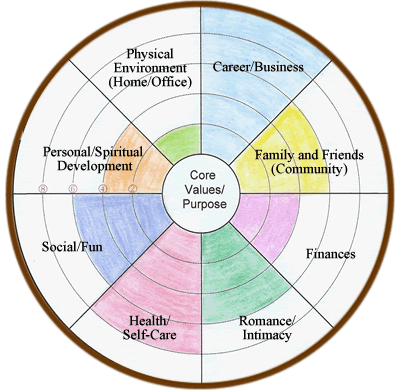
How are your connections doing?

  1. How connected are you to your past? Sometimes people want to forget it but don't realize that may be their source of getting stuck. Not being able to move forward or change our historical patterns often times is an indicator that we haven't processed the past effectively to understand it courageously and compassionately. Positive connection to the past is seeing it as part of our story which is unfolding today with greater clarity as we get better and better at understanding what happened to us with candor and grace.
  2. How about our parents? When we're young, we need our parents to provide, teach, and lead us to become independent, responsible, caring people. But that connection needs to change as we become adults; we can't really be ourselves if we're always under their authority. Healthy parents prepare their kids for launch - with no strings attached. This is even more important when / if we marry. How many dysfunctional families do you know of where moms and dads still have say over their kids' adult lives and marriages - yuck!
  3. If we're married, what about our spouses? They are the most important person on the earth for us; at least that's what we said when we married them. We are one flesh with them. God intended this relationship to be the most accurate reflection of His image. No wonder all hell breaks loose when this relationship goes south.
  4. If we have kids, how are we connecting to their hearts? So many moms and dads are preoccupied with their education and development - with truck loads of extracurriculars and recreation. And all that is incredibly important. But if the heart is ignored, neglected, or simply unknown, we miss out on what's most important - our kids' true selves and being a significant support in helping them be authentic to find their passion and purpose.
  5. How connected are we to our finances? Budgets, cash flow, investments, college savings, retirement, insurances, mortgages can create quite a complex situation. Are we educated and equipped to make healthy decisions for long term growth and stability?
  6. The future? How much thought have we given to the next decade? Do we have one left? Two? Three? Five? Will we become isolated or will we thrive in community? How long will our savings last? Will we have health to enjoy or at least minimize the health bills? To create a positive future, we need clarity, sound choices, creativity, and commitment to what's most important. Have we structured those elements as priorities?
  7. How connected are we to our health? It's common to work and work and work with minimal self care and then be shocked with acute health issues that aren't easily gotten over. Or worse, experiencing big challenges like cancer, stroke, heart attack, auto immune diseases which put huge strains on relationships and finances. Not that this is bad, but just an indicator that we need to be well connected to our health.
  8. What about our inner life? Vision, goals, fears, limitations, desires, faith, and love? What about our souls and God? Moreover, how connected are we to the ways we manage pain and stress? All those elements of our interior world reveal our frame of reference - whether we're fear-based, love-based, other-centered, God-centered, self-centered. Our inner life is the place where real security, significance and strength reside. God wants to free our inner lives to experience His power there. But too often, we neglect this most essential part of us and miss out on the amazing outcomes He intended from the beginning.
  9. How connected are we to our work? If it consumes us, we may be too connected. If we dread it, we're disengaged. If it's fulfilling, the connection is positive and meaningful! If it doesn't capture our interest and passion, maybe it's time to find new work. Does it force our loved ones to compete for our time and attention?
  10. How connected are you to what's most important to you? Your needs, wants, dreams? Growing your relationships with your loved ones, those who bring the deepest joy and peace to your heart? Love is the greatest gift of all and it is what our souls want and need the most. But are there things that keep getting in the way? What activities consistently take time away from what your heart needs the most?
  11. How connected are you to God? He's the life source - the author and completer of your life. He's the redeemer who knows everyone's reality and has empathized with us in the greatest way through Christ, His Son. Through the death and resurrection of Jesus, God has revealed His greatest, long term (eternal) solution for all our tragedies, failures, hurts, and desolations. The cross speaks of the central significance of pain and death in God's mind and heart. The resurrection proclaims the power of His Spirit to restore, renew, and even reframe our most desperate losses and deficiencies. In Christ, we have absolute hope in the midst of our overwhelming moments of loneliness and pain.

Which connections do you resonate with? If none, what connections are important to you and what are you doing with them?